Give the note one job
A page of notes can contain several different things: a copied sentence, an idea you had while reading, a question for another person and an answer you hope to hear. If they all appear in the same paragraph, it may be difficult to tell which is which later. The first task is therefore a writing task: decide what you want the note to preserve.
For the example in this article, the job is narrow. We want to keep one unclear reference findable and turn our uncertainty into a question. We are not preparing a complete health history, assessing symptoms or choosing treatment. A simple heading—“The reference I could not identify”—is enough to name that job. A different purpose would need a different note.
NIMH’s guide to talking with a health care provider suggests preparing questions and concerns before a visit. The format below is an original editorial exercise, not an NIMH worksheet or a clinically validated method. It focuses on organising language. It makes no claim about the outcome of an appointment.
Start with a fictional example
Imagine you read an educational article containing this invented sentence: “A recent review discusses several approaches to the subject.” There is no link beside the sentence, and you cannot see which review it means. This is a fictional example about a missing reference, not a real medical claim or an accusation about a particular publisher.
Your first note might say: “This article says the newest review proves the best approach. I need to know if that approach is right for me.” The sentence feels connected to the passage, but it adds several claims. “Recent” has become “newest”; “discusses” has become “proves”; and “several approaches” has become a single best option. None of those additions is established by the invented source sentence.
You do not need to decide whether the imaginary article is reliable to notice the change in wording. You can first bring the note back to what it actually says. A revised version might be: “The article mentions a recent review. I could not identify it. Which review does the author mean?” That version preserves the uncertainty instead of supplying an answer.
Separate the source, question and unknown
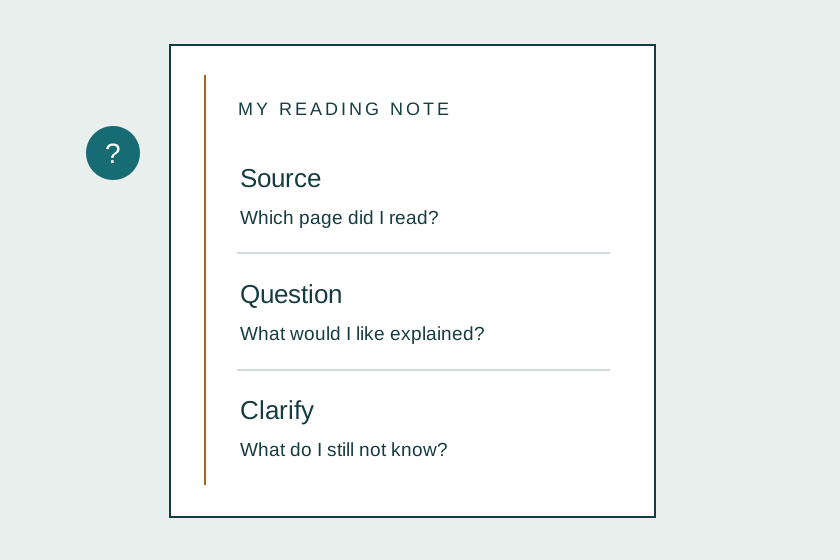
Give the note three small sections. Under “Source”, identify the article and the part you are referring to. Under “Question”, write what you would like explained. Under “Still unknown”, record the missing information. These headings are optional; their purpose is to prevent one kind of statement from quietly becoming another.
For our fictional example, the source line is: “An educational article, paragraph three, mentions a recent review.” The question is: “What is the title and date of that review, and where is it available?” The unknown line is: “I have not identified the review or read its conclusions.” Each line has a different job. Together they describe a reading situation without making a judgement about a treatment.
Notice that the unknown line is not a failure to finish the note. It is part of the note’s accuracy. Replacing it with a likely title would conceal the uncertainty. If you later locate a candidate reference, mark it as a candidate until you have a reason to connect it to the passage. A familiar title alone does not establish that connection.
Keep the original page findable
A note that says only “an article online” may be hard to revisit. Keep the page title and address, and describe the part you read. If a date is visible, preserve its label: publication date, update date or another stated purpose. If there is no date, “not stated” is clearer than using the day you happened to open the page as though it were the publication date.
The National Library of Medicine’s health-information checklist includes questions about who provides a site, its funding, where its information comes from, its currency and its privacy practices. Recording a page address does not answer all of those questions. It gives you a way to return to the evidence needed to investigate them.
For our example, a source note could include the article’s actual title followed by “paragraph beginning ‘A recent review…’”. That small locator may be more useful than several copied paragraphs with no indication of why you saved them. If you copy text for personal reference, distinguish the quoted wording from your own comments. Our source-note tool shows a shorter version of this separation.
Shorten the note without filling its gaps
Once the question is clear, you may want a version that is easier to read aloud or scan. Shortening should remove repetition, not the qualifications that make the note accurate. “Which review is meant here?” preserves the core question. “Why does the review prove this?” does not: it assumes both that you have identified a review and that it proves something.
Try reading the shortened question beside the original passage. Are you asking about the words on the page, or about a conclusion you added? Has “might” turned into “will”? Has “some” turned into “all”? This comparison is a language check. It cannot establish whether the underlying health information is correct, but it can reveal where your summary changed its scope.
You might end with two questions rather than one. The first could identify the reference; the second could ask what its findings mean in context. Keep them separate if the second depends on an answer to the first. There is no advantage in making a note look complete by merging two unanswered issues into a confident sentence.
Choose where the note belongs
The examples here contain no personal details. A note you make for a real health conversation could be different. Decide where you want to keep it and who needs to see it. This site does not collect your note, provide private messaging or offer a submission form. A reference to the exercise does not create a confidential communication channel.
If you use a shared document, a work device or another online service, consider that service’s settings and access arrangements before putting personal information there. You can also use paper. The point is not that one format is universally safer; it is that the choice of storage is separate from the choice of wording. The publication cannot inspect or manage either for you.
There is also a difference between sending someone an article link and sending your personal interpretation of it. If you share a note, make the intended question clear and avoid including unrelated private information. In our fictional example, the missing-reference question can be asked without adding a personal medical history. Another conversation may require different information, determined with the appropriate professional.
Use the note as a starting point
A note does not have to dictate the order of an entire conversation. It can simply identify the point you hoped to clarify. If an explanation introduces an unfamiliar term, you can record that term as a new question rather than pretending you understood it. If the answer refers to another source, keep its identity distinct from the source you originally read.
MedlinePlus advises discussing health information with a health care provider before relying on it for personal decisions. General information and individual relevance are different questions. The note-making exercise in this article does not bridge that gap by itself or determine which information applies to you.
After a conversation, you might add an “Answer received” section with the date and the context in which it was given. Keep it separate from your original reading note. If you are unsure whether your record reflects what was explained, mark that uncertainty and ask for clarification through the appropriate channel. Do not turn an incomplete recollection into a definitive instruction.
Know what a note cannot do
A tidy page is not a medical assessment. It cannot decide whether a symptom is urgent, determine a diagnosis, evaluate a professional’s credentials or tell you to start, stop or change treatment. It should not become a task you feel you must finish before seeking needed care. The examples here are deliberately about reading and writing, with no personal clinical recommendation.
For the fictional article, success is modest: the note now states what we read, identifies the reference we want to find and leaves its unknown details open. It has become more faithful to the available information. It has not established the quality of an imaginary review, selected an approach or answered a personal health question.
You can use the short question-note format as a reminder of that boundary. For information about this publication’s authorship and the historical domain name, see About this edition. The current article is independent editorial writing, not a statement from the professional named in the domain’s earlier profile.